
Key Takeaways
- An EICR is a legal requirement for every privately rented home in England, renewed at least once every five years.
- Since 1 May 2026, councils can fine landlords up to £40,000 for each breach of the electrical safety rules, raised from the previous £30,000.
- You must give existing tenants a copy of the report within 28 days of the inspection, and new tenants before they move in.
- Any fault coded C1 or C2 must be fixed within 28 days, with written confirmation sent to the tenant and the council.
- A standard EICR usually costs between £125 and £300, while going without one can cost you up to £40,000 in fines.
Picture a property sitting empty. The previous tenant has moved out, the rent has stopped, and you are ready to let again. Then the new tenant’s referencing agent asks for your electrical safety report, and you realise you do not have a valid one. The move in stalls, and so does your income.
That is the reality behind four words every landlord should remember: no EICR, no tenants. The Electrical Installation Condition Report is one of the few documents that can stop you letting your property altogether. Here is what it is, why it matters more than ever in 2026, and how to stay on the right side of it.
What Is an EICR and What Does It Actually Check?
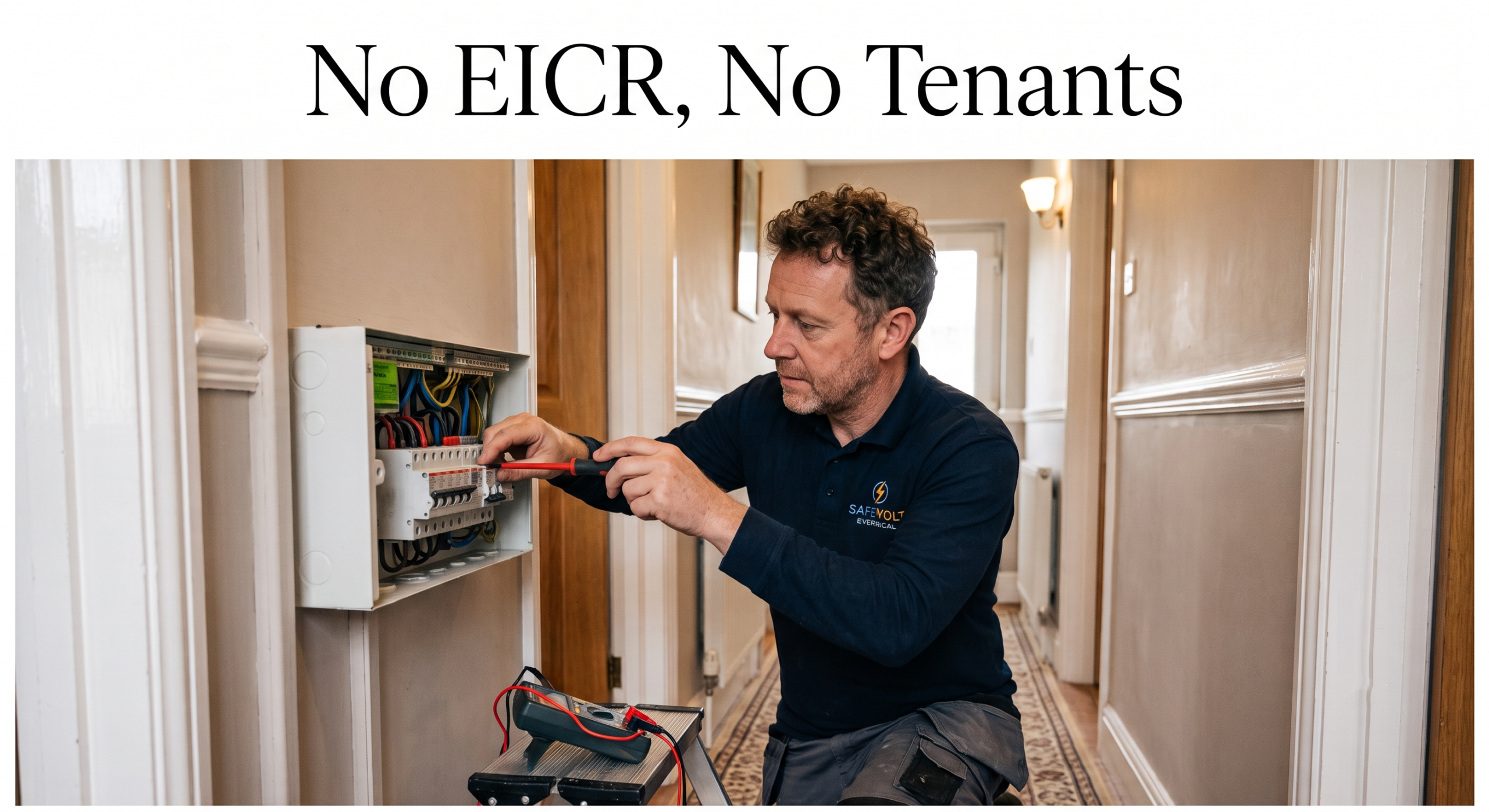
An EICR, or Electrical Installation Condition Report, is a formal assessment of the fixed electrical system in your property. A qualified electrician inspects the wiring, the consumer unit (the fuse box), sockets, switches, light fittings, and earthing. It is not about your tenant’s kettle or television. It is about the permanent installation behind the walls.
At the end of the inspection the electrician records any problems using a simple coding system. A C1 means danger is present and someone could be hurt right now. A C2 means the fault is potentially dangerous and needs attention soon. A C3 is a recommendation for improvement but not a failure. The letters FI mean further investigation is needed. A report only passes as satisfactory if there are no C1, C2, or FI findings.
Knowing these codes matters, because they decide whether your property is safe to let and what you must do next. A satisfactory EICR is your proof that the home meets the national wiring standard and is safe for the people living in it.
Is an EICR a Legal Requirement for Landlords?
Yes, and it has been since the Electrical Safety Standards in the Private Rented Sector (England) Regulations came into force. According to GOV.UK, every landlord in England must have the electrical installations in their rented homes inspected and tested by a qualified person, and must keep the property up to standard throughout the tenancy.
This is where the phrase no EICR, no tenants becomes literal. You must provide a copy of the report to any new tenant before they occupy the property. Without a valid report, a reputable letting agent will not market the home, a referencing check can flag the gap, and you expose yourself to enforcement the moment a tenant moves in. Getting your compliance paperwork in order is a core part of preparing your property to let, and the EICR sits right at the top of that list.
The rules apply to almost all assured shorthold tenancies and licences to occupy. The National Residential Landlords Association provides detailed guidance for members, but the principle is straightforward: if you let a home in England, you need a current, satisfactory EICR.
How Often Do You Need One and What Does It Cost?
The headline rule is at least every five years. That is the maximum interval, not a target. If the electrician recommends an earlier reinspection date on your report, that shorter date becomes your legal deadline. You also need a fresh inspection if the property has been rewired or the installation significantly altered.
Cost depends on the size of the property and where you are in the country. As a rough guide, expect to pay somewhere between £125 and £300 for a standard inspection on a typical flat or house. Larger properties with more circuits sit at the higher end. It is worth booking your EICR alongside your annual gas safety check where possible, since combining visits can reduce call out fees and save you chasing two separate appointments.
Always use an electrician who is genuinely qualified and registered with a recognised competent person scheme. A cheap report from an unqualified contractor is worth nothing if a council challenges it, and it puts your tenants at real risk. This is exactly the kind of detail that catches busy landlords out, and where good tenant and property management support earns its keep.
What Happens If You Ignore It: Fines and Consequences
This is where the cost of doing nothing dwarfs the cost of compliance. Local councils can issue a financial penalty for each breach of the regulations, and since 1 May 2026 that maximum rose to £40,000 per offence, up from £30,000. Councils no longer have to go to court first. They can serve a civil penalty notice directly.
The breaches are easy to trip over. Failing to have the inspection done, failing to give the tenant a copy within 28 days, failing to send the report to the council within seven days of a request, or failing to fix a C1 or C2 fault within 28 days all count. After remedial work you must obtain written confirmation that the installation is now safe and pass it to your tenant and the council.
There is a knock on effect too. An expired or missing EICR can invalidate your landlord insurance, complicate any future possession claim, and damage your standing if a dispute ever reaches a tribunal. A few hundred pounds spent on time protects you from all of it.
An EICR is not red tape for its own sake. It is the simplest, cheapest insurance you can buy against a £40,000 penalty, an invalid insurance policy, and a property you cannot legally let. The five yearly cycle is easy to track once you know your renewal date, and the inspection itself is usually done in a few hours.
If you take one thing from this, let it be the renewal date on your current report. Put it in your calendar, book the next inspection well before it lapses, and keep the paperwork somewhere you can find it in minutes. The landlords who get caught out are rarely careless. They simply lost track of a date.
Every property and every portfolio is different, and the right approach depends on your circumstances. Whether you are letting your first home or managing several, the team at Yeti Homes has spent over 20 years keeping landlords compliant without the stress. If you would like a hand staying on top of your electrical safety and wider obligations, get in touch with the team at Yeti Homes and we will talk you through your options.
Frequently Asked Questions
Q: Can I let my property without a valid EICR?
Ans: No. You must give a new tenant a satisfactory EICR before they move in and keep a valid one in place throughout the tenancy. Letting without one breaches the regulations.
Q: Who is qualified to carry out an EICR?
Ans: A competent, qualified electrician registered with a recognised scheme such as the National Inspection Council for Electrical Installation Contracting (NICEIC) or the National Association of Professional Inspectors and Testers (NAPIT). Always ask to see their registration before they start.
Q: What is the difference between an EICR and a PAT test?
Ans: An EICR checks the fixed wiring built into the property. A PAT test checks plug in appliances. The EICR is legally required, PAT testing usually is not.
Q: Does an EICR cover a new build or recently rewired property?
Ans: Not at first. A new installation comes with an Electrical Installation Certificate, but you still need a full EICR within five years of that date.
Q: What do the EICR codes C1, C2, and C3 mean?
Ans: C1 means immediate danger, C2 means potentially dangerous, and C3 is a recommendation only. Any C1 or C2 makes the report unsatisfactory until fixed.